
28 July 2026 9 menit
El Niño Emergency Through 2027: Indonesian Civil Society Urges Banks to Stop Financing Destroyers of Forest and Peatland
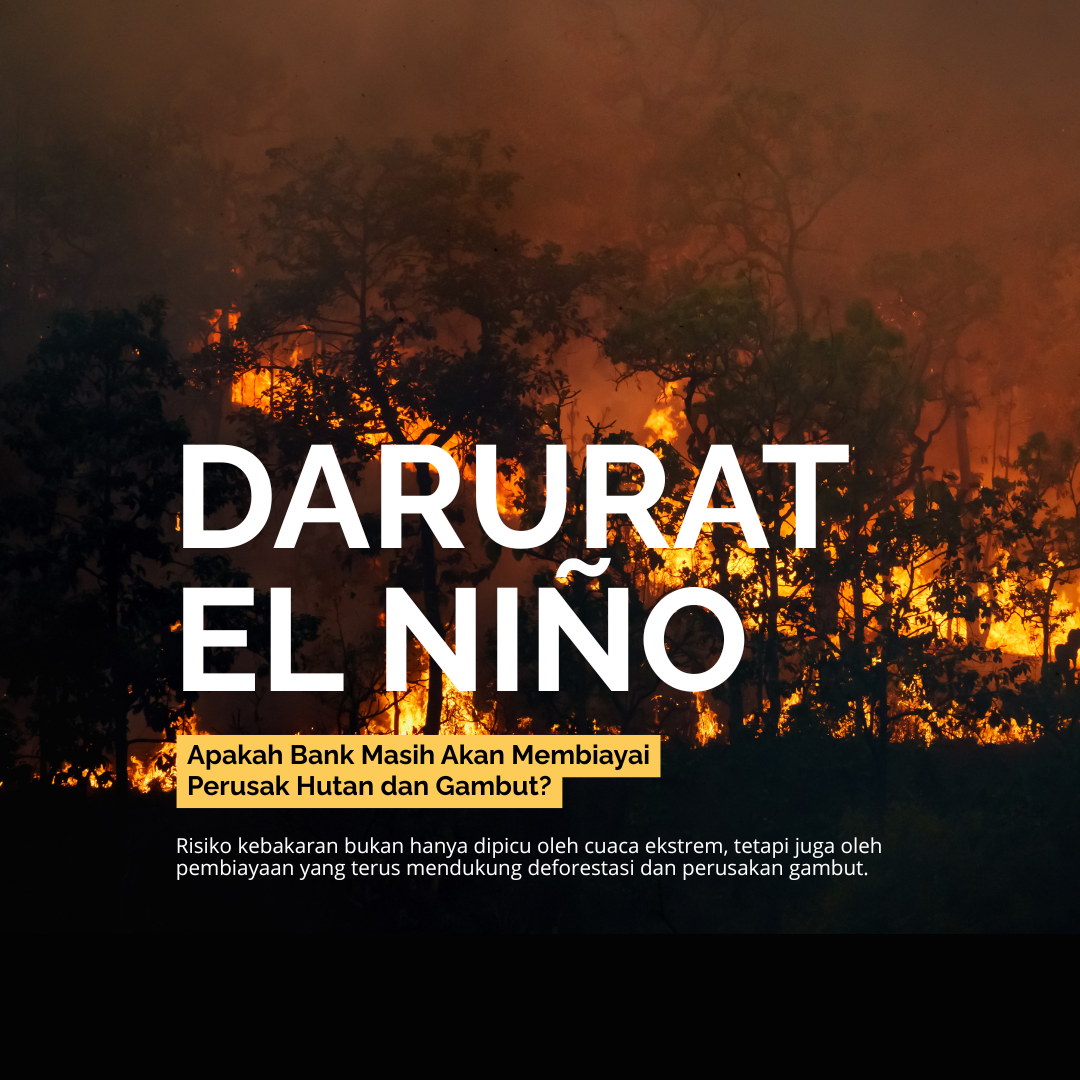
Jakarta, 28 July 2026 — Indonesian civil society, together with a number of civil society organizations (CSOs) from various countries, is urging the banking sector to strengthen financing accountability toward sectors at risk of driving deforestation and forest fires. The call was delivered through an open letter sent to 190 financial institutions across various countries, ahead of the potential intensification of the El Niño phenomenon expected to persist through 2027. In Indonesia, the letter was addressed to Bank Rakyat Indonesia (BRI), Bank Mandiri, Bank Negara Indonesia (BNI), Indonesia Eximbank, Panin Bank, and Bank Danamon Indonesia.
Based on projections from the National Oceanic and Atmospheric Administration (NOAA) and the World Meteorological Organization (WMO), El Niño is expected to develop into a moderate-to-strong category through 2027. This condition could increase drought in tropical regions, heighten the risk of forest and land fires, and threaten food security and community livelihoods.
These risks have already begun to materialize since the start of the year. Nusantara Atlas data shows that as of June 2026, the cumulative burned area in Indonesia had reached 103,144 hectares. The ten provinces with the largest burned areas include East Nusa Tenggara, West Kalimantan, Riau, South Papua, West Nusa Tenggara, Maluku, Riau Islands, East Java, Central Papua, and Southeast Sulawesi. Meanwhile, as of 27 July 2026, the cumulative number of fire hotspots in Indonesia reached 96,736, with West Kalimantan recording the highest number at 14,933 hotspots, or roughly 15% of the national total — indicating the province’s high vulnerability to forest and land fires.
Meanwhile, data from Forests & Finance shows that between 2016 and 2025, global financial institutions channeled at least US$429 billion to the timber, soy, rubber, pulp and paper, palm oil, and cattle ranching sectors — sectors that are major drivers of deforestation and contribute to rising forest and peatland fire risk. In addition, between 2016 and 2024, banks also disbursed US$32 billion in loans and underwriting to mining operations in Indonesia. Of that amount, the 20 largest banks accounted for about 81%, or US$26 billion (around Rp386 trillion), with Bank Mandiri as the largest financier at US$6.4 billion (around Rp96 trillion). The scale of this financing flow shows that the financial sector plays a critical role in either driving or preventing environmental destruction through its financing policies.
TuK INDONESIA Executive Director Linda Rosalina said that while El Niño is indeed a natural phenomenon, the scale of fire impacts is determined by how forests and land are managed. She noted that fire risk is worsened by forest clearing, peatland drainage, and financing decisions that continue to support such practices. “El Niño cannot be prevented, but its impact can be minimized if the financial sector stops funding business models that destroy forests. For that reason, the financial sector cannot position itself as a neutral party in the face of the climate crisis,” said Linda.
TuK INDONESIA also highlighted the importance of comprehensive due diligence across banks’ entire financing portfolios. One case of particular concern is Bank Danamon Indonesia, majority owned by Mitsubishi UFJ Financial Group (MUFG). Although MUFG and Bank Danamon have adopted a No Deforestation, No Peat, No Exploitation (NDPE) policy for palm oil sector financing, a 2025 Rainforest Action Network (RAN) report found that Bank Danamon still provided US$281 million in credit facilities to PT Tunas Baru Lampung Tbk (TBLA) between 2020 and 2022 — a company reported to have converted thousands of hectares of peatland in South Sumatra and which experienced fires within its concessions in 2023.
TBLA’s subsidiary, PT Dinamika Graha Sarana (PT DGS), has also been found liable for land fires by the Kayuagung District Court and ordered to pay damages and carry out environmental restoration, although the legal proceedings in the case remain ongoing. According to Linda, this case shows that sustainability commitments must be proven through consistent implementation, not merely exist as corporate policy. “NDPE commitments must be implemented through due diligence covering all clients and financing portfolios. Without that, sustainability policies will remain mere promises on paper, while ecological damage and social costs continue to be borne by communities,” she stressed.
Echoing this, PWYP Indonesia National Coordinator Aryanto Nugroho affirmed that the financial sector’s commitment to not fund forest and peatland destroyers would remain illusory if it continues to finance the mining sector and coal-fired power plants. “Bank sustainability policies must not be selective — stop financing peatland destroyers, halt funding for mining, and swiftly retire support for coal power plants,” Aryanto emphasized.
PRAKARSA Executive Director Victoria Fanggidae pointed out that banks’ readiness to face this risk is already measurable. The Bank Rating Report issued by the ResponsiBank Indonesia Coalition placed the average bank policy score at just 2.1 out of a maximum of 10. On forestry themes specifically, the average score rose from 1.1 in 2022 to 2.0 in 2024 — still far from adequate. “A score this low means that most banks’ forestry policies have not yet reached decisive measures, such as bans on peat conversion, respect for community rights, and supply chain transparency. Ahead of El Niño, these policy weaknesses translate into real risks on the ground,” said Victoria. She urged Indonesia’s Financial Services Authority (OJK) to strengthen the Indonesian Sustainable Finance Taxonomy and issue binding implementing regulations, accompanied by independent audits and incentive/disincentive schemes, so that banks’ sustainability commitments can be verified.
Pantau Gambut National Coordinator Iola Abas explained: “Pantau Gambut’s analysis found that around 3 million hectares of peatland burned between 2015 and 2024, with a significant increase during El Niño years. El Niño must not be used as an alibi when peatlands burn. The phenomenon does increase drought and fire risk, but it is not the sole cause of disaster. Its impact becomes far greater when peatlands have already been drained, converted, and left without restoration. Ahead of the 2026/2027 El Niño, the government must evaluate concessions that have repeatedly burned and ensure that hydrological function restoration is genuinely carried out. Financial institutions should also stop propping up business activities that sustain this vulnerability. If this condition is allowed to continue, peatlands will remain vulnerable to fire, while the impacts and recovery costs continue to be borne by communities.”
Amid the looming El Niño emergency, the Head of the Forestry and Biodiversity Division at the Indonesian Center for Environmental Law (ICEL), Adam Putra Firdaus, stressed that forest and peatland destruction should not be viewed merely as the actions of on-the-ground perpetrators, but also as the result of financing flows that sustain destructive activities. He argued that it is time for financial institutions to no longer be seen as neutral parties, but as actors who must also be held accountable if they continue to provide financing to those responsible for forest and peatland destruction. “From a civil law perspective, such actions can be linked to the doctrine of tortious liability [perbuatan melawan hukum], particularly where there is negligence in applying adequate due diligence, or where financing continues to be provided despite environmental damage and its impact on public safety having been known from the outset. No financial gain should be built on financing that destroys forests and peatlands and worsens the climate crisis,” said Adam.
Responding to the high fire risk in West Kalimantan, WALHI West Kalimantan Regional Executive Director Sri Hartini said the province has around 2.79 million hectares of peatland, now burdened with at least 135 oil palm plantation permits, 35 Forest Utilization Business Permits (PBPH), and 123 Mining Business Permits (IUP). She noted that following the major 2015 fires, WALHI West Kalimantan found that many companies’ concessions had burned due to poor peatland management, including the construction of canals that drained peatlands and increased their vulnerability to fire. To date, restoration of burned areas has not been adequately carried out, while sanctions imposed have failed to produce a deterrent effect. “As a result, practices that damage peatland ecosystems keep recurring, and fire risk remains high. That’s why financial institutions must stop providing financing to businesses that continue this repeated damage,” Sri Hartini stressed.
A similar condition is faced by Jambi Province, which has long been one of the regions with a high level of forest and land fire vulnerability. WALHI Jambi Regional Executive Director Oscar Anugrah affirmed that the banking sector must not simply act as a capital provider without taking responsibility for the impact of its financing. Every financing decision must be ensured not to support forest destruction, environmental law violations, or the seizure of communities’ living spaces. He noted that the threat of El Niño in the 2026/2027 period could magnify the risk of recurring forest and land fires in Jambi. “Financial sector accountability is a crucial part of ending the ecological crisis. Banks must ensure that the financing they channel does not worsen environmental damage, but instead promotes fair and sustainable natural resource governance,” Oscar stressed.
Through the open letter, civil society organizations from various countries are urging financial institutions to strengthen NDPE policies, ensure that all clients in at-risk sectors do not use fire or engage in forest and peatland conversion, halt financing to companies that fail to meet these commitments, increase support for sustainable agricultural practices such as agroecology and agroforestry, and refrain from providing new financing, refinancing, or underwriting services to companies that have been held legally liable for forest and land fires until all environmental restoration obligations have been fulfilled.
Note:
Mitsubishi UFJ Financial Group (MUFG) and Bank Danamon adopted a No Deforestation, No Peat, No Exploitation (NDPE) policy in 2021 for palm oil sector financing. A 2025 Rainforest Action Network (RAN) report found that Bank Danamon still provided US$281 million in credit facilities to PT Tunas Baru Lampung Tbk (TBLA) between 2020 and 2022. The report states that TBLA converted nearly 7,800 hectares of peatland in South Sumatra. In 2023, fires occurred in two concessions managed by the company. Separately, through Kayuagung District Court Decision No. 38/Pdt.Sus-LH/2024/PN Kag dated 16 June 2025, PT Dinamika Graha Sarana (PT DGS), a TBLA subsidiary, was found liable for fires covering 6,360 hectares of land. The court ordered the company to pay Rp184.39 billion in environmental damages and carry out environmental restoration valued at approximately Rp1.79 trillion. TBLA has previously denied various allegations regarding alleged peatland destruction.
This post is also available in: Indonesian